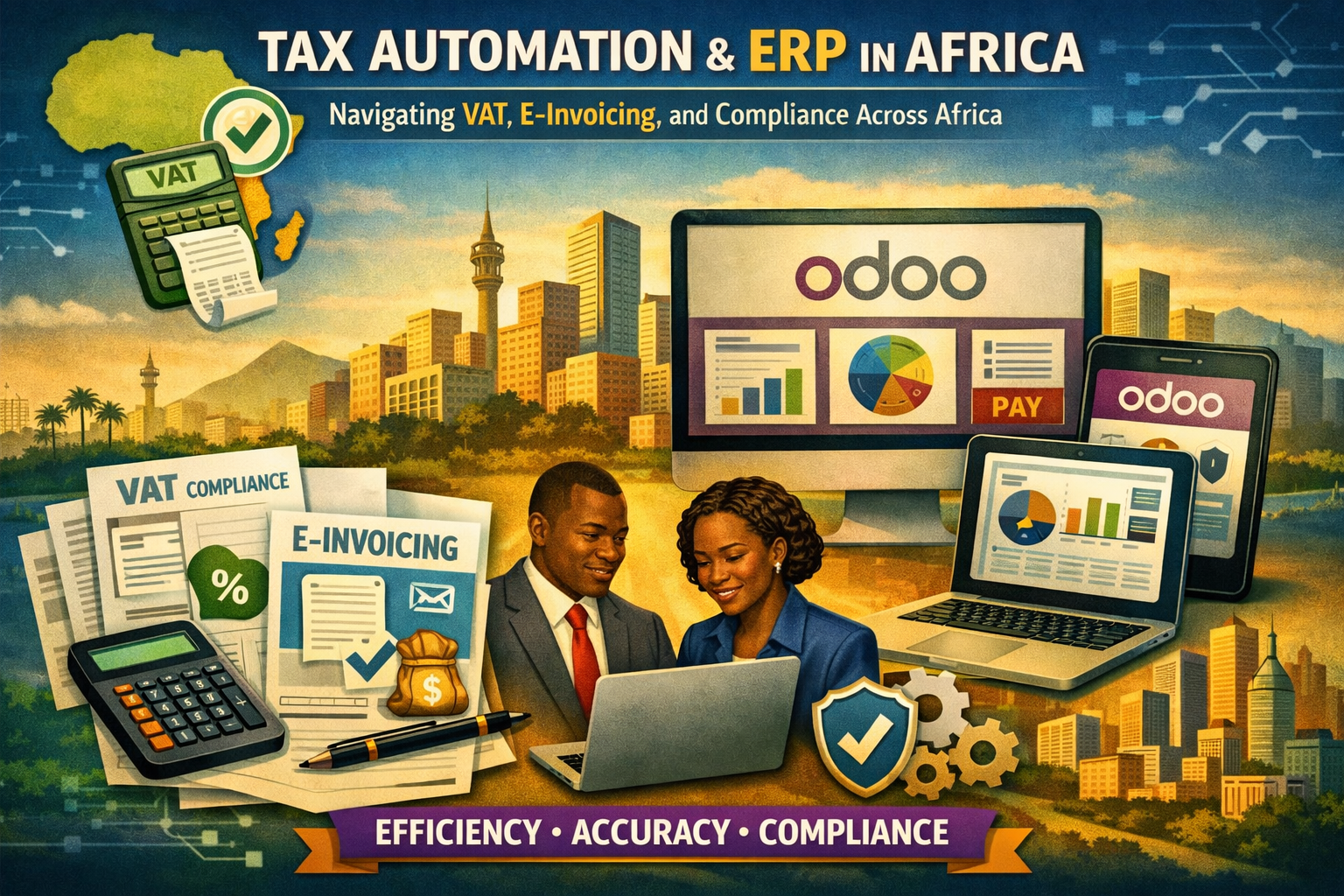
Tax Automation and ERP: Navigating VAT, E-Invoicing, and Compliance Across Africa
In this article
Introduction
Africa’s tax landscape is undergoing a profound transformation. Governments across the continent are digitizing revenue collection, closing loopholes, and deploying real-time reporting mandates that fundamentally change how businesses interact with tax authorities. For companies accustomed to manual invoicing and periodic filing, this shift is not merely a regulatory update. It is an operational challenge that demands integrated technology. ERP systems, with their ability to embed tax compliance directly into transactional workflows, are emerging as the essential bridge between business operations and the new digital tax infrastructure.
The Fiscal Problem Driving Digital Tax Reform
The scale of the fiscal problem that e-invoicing and tax automation seek to address is substantial.
In Nigeria, the Revenue Service estimates that more than N500 billion is lost annually to tax leakages.
Much of this is linked to manual invoicing, under-reporting, and poor documentation of transactions.
The response has been the rollout of the Electronic Fiscal System, which introduces mandatory e-invoicing for medium taxpayers from July 1, 2026.
Under this framework, invoices must be validated by the tax authority before transactions are considered fully compliant. This represents a shift to a real-time “pre-clearance” tax model.
What the New Rules Mean for Your Business
For businesses, the implications are immediate and significant.
Every invoice must be generated in a compliant format.
Each invoice must be transmitted to the tax authority for validation.
Approval must be received before the invoice is considered legitimate.
Failure to comply carries penalties including administrative fines of N200,000 and tax surcharges of up to 100 percent on unreported transactions.
Manual processes simply cannot meet these demands at scale. A business processing hundred or thousands of invoices per month cannot manually submit each one for pre-clearance and track the validation of responses.
How ERP Integration Solves the Compliance Challenge
This is where ERP integration becomes critical. Companies like Duplo have secured dual licences as both Systems Integrator and Access Point Provider for Nigeria’s e-invoicing framework. This enables businesses using major enterprise platforms such as SAP, Oracle, QuickBooks, and Microsoft Dynamics to automatically generate compliant invoices and route them to the tax authority without manual intervention. Through such integrations, the following happens automatically.
Invoices created in the ERP are validated against the tax authority’s schema.
They are sent for approval.
A unique Invoice Reference Number and QR code are assigned for verification.
Payments can be reconciled instantly once an invoice has been validated.
This eliminates what industry experts describe as the “reconciliation lag” that often leads to financial discrepancies in corporate accounts.
Beyond Penalties: The Strategic Benefits of Tax Automation
The benefits of ERP-driven tax automation extend beyond avoiding penalties.
By embedding tax logic directly into payment and invoicing workflows, businesses gain real-time visibility into their tax positions.
Automated validation checks prevent errors before invoices are submitted, reducing rejection rates and the associated delays.
Compliance-ready reports can be generated at the press of a button, eliminating the scramble that characterizes manual tax filing periods.
The audit trail created by an integrated ERP system provides a defensible record of every transaction, every tax calculation, and every submission.
A Continental Trend with Multi-Jurisdiction Implications
This shift toward tax automation is not limited to Nigeria. Across the continent, tax authorities are deploying digital reporting systems designed to reduce fraud, improve transparency, and boost revenue mobilization. The trend aligns with broader global patterns where governments seek to close tax gaps through technology rather than through expanded audit functions.
For businesses operating across multiple African jurisdictions, the complexity multiplies. Different countries have different requirements, different thresholds, and different technical standards.
An ERP system configured for multi-country tax compliance becomes not just an efficiency tool but a strategic necessity.
What This Means for African SMEs
For African SMEs, the link between tax automation and business growth is particularly important.
Taiwo Oyedele, Chairman of Nigeria’s Presidential Committee on Fiscal Policy and Tax Reforms, has emphasized that businesses must maintain proper records and strengthen internal structures to fully benefit from tax reforms.
An ERP system that automates tax compliance while also providing the business intelligence needed for growth serves both objectives simultaneously.
As Yele Oyekola, CEO of Duplo, has stated, “You don’t scale payment operations by adding headcounts. You scale by automating decisions and standardizing the infrastructure of your business.”
Conclusion
Tax compliance is moving from periodic reporting to continuous, transaction-level validation. Businesses that rely on manual processes will struggle to keep pace and will incur penalties in the process. ERP-driven tax automation offers the only scalable path to compliance in this new environment. The investment pays itself through avoided penalties, reduced administrative overhead, and the confidence of always knowing your tax position is accurate and audit ready.
Call to Action
Review your current invoicing and tax filing processes.
How much time does your finance team spend on manual invoice preparation and tax reconciliation?
If Nigeria’s e-invoicing deadlines apply to your business, or if you operate in any jurisdiction moving toward digital tax reporting, act now.
Contact your ERP provider or an accredited systems integrator to assess your readiness.
The window for preparation is closing. The cost of inaction is rising.