Introduction
Manufacturing has always been about precision, timing, and efficiency. In Africa, where industries are rapidly scaling to meet local and global demand, the ability to make decisions in real time is becoming the defining factor between success and failure. Without real‑time data, manufacturers face inefficiencies, delays, and wasted resources that erode competitiveness.
This article explores why real‑time data is now indispensable for African manufacturers, the challenges of operating without it, and how ERP and analytics are reshaping the industry.
The Challenge of Operating Without Real‑Time Data
Manufacturers relying on manual reporting or fragmented systems encounter:
- Delayed decision‑making: Managers wait days for reports.
- Inventory errors: Stockouts or overstocking disrupt production.
- Hidden bottlenecks: Production inefficiencies remain unnoticed.
- Compliance risks: Inaccurate records complicate audits.
In Zimbabwe, for example, manufacturers often struggle to reconcile inventory manually, leading to costly production delays.
Why Real‑Time Data Matters
1. Predictive Maintenance
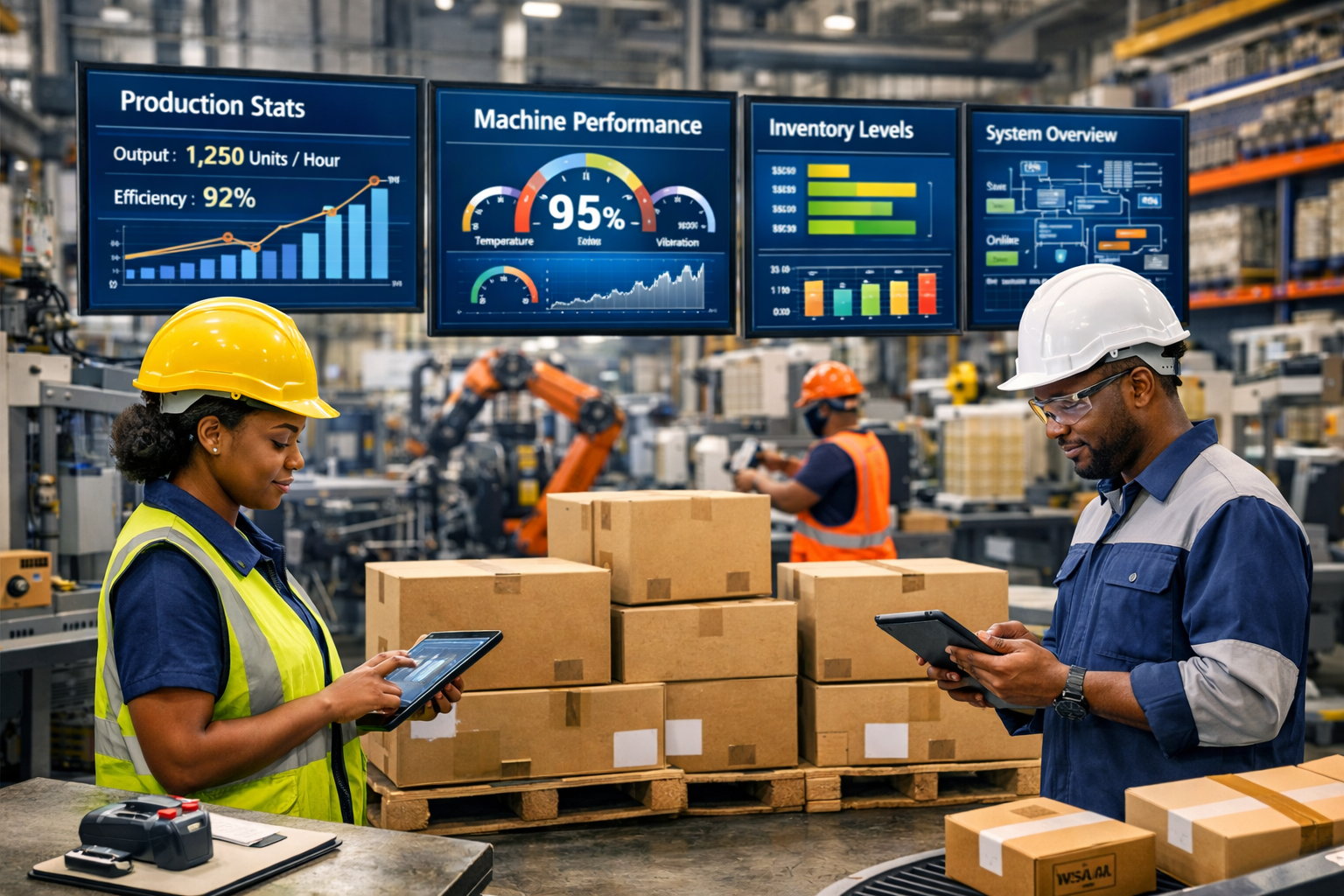
Sensors and ERP systems monitor machinery, predicting failures before they occur. This reduces downtime and extends equipment lifespan.
2. Supply Chain Visibility
Real‑time tracking ensures raw materials arrive on time and finished goods reach markets efficiently.
3. Agile Decision‑Making
Executives can respond instantly to market changes, adjusting production schedules or pricing strategies.
4. Compliance and Governance
Accurate, real‑time records simplify tax filings, labour law compliance, and audits.
Case Studies in Africa
- Zimbabwean Firms: Manufacturers adopted ERP before investing in new machinery, realizing that without real‑time data, productivity gains were impossible.
- Nigerian Manufacturers: IoT sensors provided real‑time monitoring, reducing downtime by 25%.
- South African Enterprises: Companies using analytics improved supply chain efficiency, cutting delivery times by 30%.
The Role of ERP Systems
ERP platforms integrate finance, HR, inventory, and production into one system. Benefits include:
- Unified data: Eliminates silos across departments.
- Automation: Reduces manual reporting.
- Analytics dashboards: Provide instant visibility into KPIs.
- Scalability: Systems grow with the business.
Solutions like Odoo ERP, SAP Business One, and Microsoft Dynamics 365 are increasingly adopted across Africa.
Challenges in Adoption
Despite the benefits, African manufacturers face hurdles:
- Cost barriers: ERP systems require upfront investment.
- Infrastructure gaps: Limited internet access in rural areas.
- Change resistance: Employees accustomed to manual processes may resist digitization.
Actionable Steps for African Manufacturers
1. Audit Current Processes — identify inefficiencies in reporting and production.
2. Select Scalable ERP Platforms — choose systems that fit company size and growth plans.
3. Train Staff — ensure employees understand digital tools.
4. Integrate IoT Sensors — enable predictive maintenance and monitoring.
5. Monitor KPIs — track production efficiency, downtime, and supply chain performance.
Conclusion
Manufacturing in Africa without real‑time data is no longer viable. The industry’s future depends on ERP systems, IoT sensors, and analytics that provide instant visibility into operations. Companies that embrace real‑time data will reduce inefficiencies, improve compliance, and gain a competitive edge in both local and global markets.
Call‑to‑Action
African manufacturers should prioritize ERP and analytics adoption now. Those who digitize their operations will lead the continent’s industrial transformation.