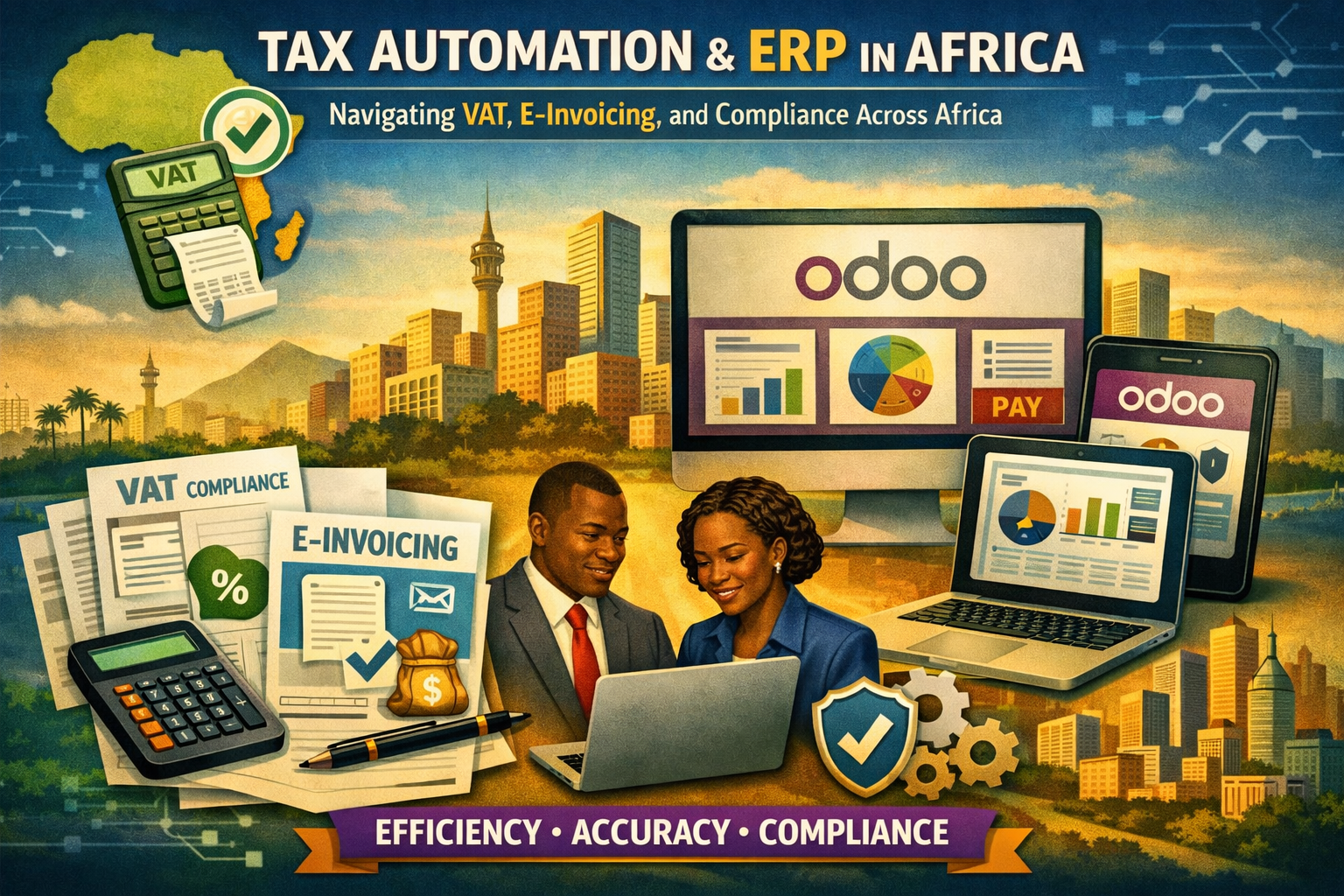
Running a business across multiple African countries is one of the most complex operational challenges a company can face. You are dealing with different currencies, distinct tax authorities, varied regulatory frameworks, and teams spread across borders — often while trying to keep costs under control and maintain a single, clear picture of your overall performance.
For businesses operating in Zimbabwe, Zambia, and across the broader African continent, Odoo ERP has emerged as the platform of choice for taming this complexity. Its multi-company architecture, multi-currency accounting, and localization capabilities for tax authorities like ZIMRA and ZRA make it uniquely suited to the pan-African business environment. This guide walks you through exactly how Odoo supports cross-border African operations — from group consolidation and intercompany transactions to local compliance and real-time reporting.
Why Pan-African Operations Demand a Unified ERP
Many regional businesses start with a patchwork of tools: one accounting system in Harare, a different invoicing platform in Lusaka, spreadsheets tying it all together. This approach works until it doesn’t. As transaction volumes grow, the cracks appear — duplicate data entry, reconciliation errors, delayed month-end reporting, and compliance gaps that invite penalties from tax authorities.
The core challenge of pan-African operations is not simply scale. It is complexity compounded by fragmentation. Each operating country brings its own:
- Functional currency and exchange rate fluctuations
- Tax authority requirements (ZIMRA in Zimbabwe, ZRA in Zambia, KRA in Kenya, and so on)
- Company registration and reporting obligations
- Payroll structures and local labour regulations
- Banking relationships and payment methods
A fragmented technology stack amplifies every one of these challenges. A unified ERP platform like Odoo eliminates the fragmentation by placing all entities within a single, integrated system — while still allowing each subsidiary to operate according to its own local rules.
Odoo’s Multi-Company Framework: One System, Many Entities
The foundation of any pan-African Odoo deployment is the multi-company module. This architecture allows you to create and manage multiple legal entities within a single Odoo database or across linked databases, depending on your scale and data governance requirements.
Each company in the system maintains its own:
- Chart of accounts and financial statements
- Tax configuration and fiscal positions
- Warehouse and inventory records
- Customer and vendor relationships
- User access controls
At the same time, designated users — typically group finance or management teams — can switch between companies or access consolidated views without logging in and out of separate systems. This creates a clear operational boundary between entities while giving group leadership the visibility they need.
Intercompany transactions are where this architecture truly proves its value. When your Zambian subsidiary purchases goods from your Zimbabwean entity, Odoo can automatically generate the corresponding purchase order on one side and the sales order on the other. Stock movements, invoices, and accounting entries are created automatically, eliminating manual reconciliation and reducing the risk of intercompany mismatches during audits.
Multi-Currency Accounting for African Markets
Africa’s currency environment is unlike almost anywhere else in the world. Zimbabwe operates a multi-currency economy, with the Zimbabwe Gold (ZiG) and USD both in active use. Zambia transacts in ZMW. Cross-border businesses often invoice in USD while reporting locally in functional currency. Exchange rates shift, and the timing of conversions matters enormously for both financial accuracy and tax compliance.
Odoo’s accounting engine handles this complexity through a robust multi-currency framework that allows you to:
- Define a functional currency for each entity
- Set live or manual exchange rates per currency pair
- Revalue foreign currency balances at period-end automatically
- Record realized and unrealized exchange gains and losses
- Generate financial statements in any currency for group reporting
For Zimbabwean businesses, this means you can maintain USD-denominated books, process ZiG transactions, and produce ZIMRA-compliant reports — all within the same system. For Zambian entities, ZMW accounting runs alongside USD intercompany flows, with VAT calculated at the correct 16% rate and submitted to ZRA through the Smart Invoice integration.
When your group CFO needs a consolidated view, Odoo’s reporting tools aggregate results across currencies, applying group exchange rates for like-for-like comparisons. This transforms what was once a multi-day consolidation exercise into a report that refreshes in real time.
Tax Compliance Across Borders: ZIMRA, ZRA, and Beyond
Regulatory compliance is the area where pan-African ERP deployments most frequently run into trouble. Each tax authority operates its own systems, deadlines, and data formats. Getting this wrong is expensive — penalties, interest, and reputational risk with revenue authorities can significantly impact a business.
Odoo addresses this through country-specific tax localization, which configures the system to meet each jurisdiction’s requirements out of the box, with local Odoo partners providing deeper customization where needed.
ZIMRA Compliance in Zimbabwe
In Zimbabwe, ZIMRA oversees VAT, corporate tax, PAYE, and withholding taxes. Odoo can be configured with Zimbabwe’s tax rates and fiscal positions, and integration with ZIMRA’s Fiscal Device Management System (FDMS) is available through certified partner modules. This allows businesses to generate fiscalized invoices that meet ZIMRA’s audit requirements, while Odoo’s accounting module tracks VAT liabilities, generates VAT3 return data, and maintains the audit trail ZIMRA expects during investigations.
ZRA Smart Invoice Compliance in Zambia
Zambia has one of Africa’s most advanced e-invoicing mandates. The ZRA Smart Invoice system requires all VAT-registered businesses to transmit invoices to ZRA in real time at the point of issuance. Odoo has received official ZRA approval, and Smart Invoice connectors are available that automate the entire process. When your team raises a customer invoice in Odoo, it is transmitted to ZRA instantly, receives an official invoice number, and is locked against editing — meeting ZRA’s tamper-proof requirements.
VAT is configured at Zambia’s standard 16% rate, with zero-rated items flagged appropriately, and automated reminders ensure your finance team meets the monthly 16th-day VAT return deadline without last-minute scrambling.
Expanding into East and West Africa
As your operations grow into Kenya, Ghana, Nigeria, or other African markets, Odoo’s partner ecosystem supports additional localizations. The principle remains the same: configure each entity’s tax rules, connect to the relevant revenue authority’s systems, and let Odoo automate the compliance workflow. Your group ERP scales as your footprint expands, without requiring a separate system in each new country.
Group Reporting and Consolidated Financials
For group CFOs and boards, the ultimate test of any pan-African ERP is the quality and speed of consolidated reporting. Traditional approaches involve exporting data from multiple systems, converting currencies manually in spreadsheets, and spending days resolving intercompany eliminations before a consolidated balance sheet can be produced.
Odoo changes this equation in several important ways.
Intercompany eliminations are handled systematically when intercompany transactions are processed correctly within the system. Because both sides of every intercompany sale, purchase, or loan are recorded in Odoo, the consolidation engine can identify and eliminate these balances automatically.
Group dashboards give management real-time visibility into revenue, margins, cash positions, and key KPIs across all entities simultaneously. Rather than waiting for monthly management accounts, your leadership team can monitor performance daily and intervene early when any subsidiary shows signs of underperformance or cash pressure.
Segment reporting allows you to slice financial data by entity, country, product line, or project — giving investors and lenders the granularity they require while keeping the underlying data in one place.
Managing Inventory and Supply Chains Across Borders
For businesses in manufacturing, agriculture, retail, or distribution, inventory management across multiple African locations presents a particular challenge. Stock needs to move between countries, customs documentation must be managed, and landed cost calculations affect profitability reporting.
Odoo’s inventory and logistics modules support multi-warehouse, multi-location operations with full traceability of stock movements across borders. Key capabilities for pan-African operations include:
- Landed cost allocation: Automatically distribute freight, duties, and clearing costs to the cost of goods received across border, giving you accurate product margins by country.
- Demand forecasting per location: Set reorder rules independently for each warehouse so that your Lusaka distribution centre and Harare factory maintain optimal stock levels without over-purchasing.
- Serial and lot tracking: Maintain full traceability of serial numbers and lot numbers as products move between companies — critical for regulated industries and ZRA/ZIMRA audit readiness.
- Cross-company procurement: Your Zambian entity can raise a purchase order against your Zimbabwean manufacturing entity directly in Odoo, triggering the production order, warehouse transfer, and intercompany invoice automatically.
This level of integration eliminates the information delays that typically plague cross-border supply chains, where finance teams in one country often do not know what stock is in transit until days after it has crossed the border.
Human Capital Management Across African Jurisdictions
Managing employees across multiple African countries means navigating different labour laws, payroll structures, and statutory deductions. Odoo’s HR and payroll modules can be configured per entity to reflect local requirements, including:
- PAYE tax brackets specific to Zimbabwe or Zambia
- NAPSA contributions for Zambian employees
- NSSA contributions for Zimbabwean employees
- Leave policies and accrual rules aligned to local labour law
Payroll runs are processed per entity but are visible to group HR leadership, enabling consolidated headcount reporting, compensation benchmarking, and group-wide talent planning. As you expand into new African markets, adding a new payroll entity in Odoo requires configuring the local structure rather than implementing a new system — significantly reducing the cost and timeline for each expansion.
Implementation Strategy for Pan-African Odoo Deployments
Successfully rolling out Odoo across multiple African countries requires a structured approach. The scale and complexity demand more careful planning than a single-entity implementation.
A proven framework for pan-African Odoo deployments involves five key phases:
- Group architecture design: Define your company structure, intercompany flows, consolidated reporting requirements, and data governance rules before a single module is configured. This design phase prevents costly rework later.
- Template entity implementation: Build and test a fully configured template entity — typically the group’s largest or most complex subsidiary — that establishes the standards for chart of accounts, tax configuration, workflows, and reporting.
- Localization per country: Adapt the template for each additional jurisdiction, adding country-specific tax rules, fiscal device integrations, local payroll configurations, and banking connectors.
- Data migration and integration: Migrate historical data from legacy systems and configure integrations with banking platforms, revenue authority systems, and any third-party tools the business relies on.
- Phased go-live and training: Roll out entity by entity, training local teams on their workflows and providing hypercare support during the critical first weeks of operation.
Partnering with an experienced African Odoo implementation specialist is essential at every stage. Navigating ZIMRA’s FDMS integration requirements, ZRA’s Smart Invoice certification, and local chart of accounts conventions requires partners with boots-on-the-ground knowledge that generic global implementers simply do not have.
The Business Case for a Unified Pan-African ERP
The investment in a pan-African Odoo deployment is significant — but so is the cost of not making it. Businesses that continue to operate fragmented systems across borders face compounding inefficiencies that grow as they scale.
The measurable returns typically include:
- Reduced finance headcount needed for manual consolidation, reconciliation, and reporting
- Faster month-end close, often from weeks down to days for multi-entity groups
- Lower compliance risk through automated tax submissions and audit-ready records
- Better working capital management through real-time visibility into cash positions across all entities
- Accelerated new market entry, as adding a new country entity to an established Odoo platform is far cheaper than implementing a new standalone system
For growing African groups, Odoo’s modular, subscription-based pricing model also means that smaller subsidiaries can operate on a lean module set while the core system scales up as each entity matures.
Conclusion
Pan-African operations do not have to mean pan-African complexity. With the right ERP platform and an experienced implementation partner, you can run multiple entities across Zimbabwe, Zambia, and the wider continent from a single, coherent system that delivers real-time visibility, automated compliance, and a consolidated financial picture at any moment.
Odoo’s multi-company architecture, multi-currency accounting, and deep integrations with ZIMRA and ZRA make it the most capable platform available for African groups today. The key is implementing it correctly — with a group-first architecture design, strong local localization, and ongoing support from partners who understand the African regulatory environment.
Ready to unify your pan-African operations on Odoo? SERPA Africa specializes in multi-entity, cross-border Odoo implementations across Zimbabwe, Zambia, and the broader African continent. Contact our team to discuss your group structure and find out how we can design an Odoo environment that gives your business the control and visibility it needs to grow.